When my Grandma died I had prepared myself for grief, or tried to. You know that losing someone you love will be hard: waves of sadness, empty chairs at the kitchen table, phone calls that go unanswered, habits, traditions, and holidays that will never feel the same. What I wasn't prepared for was how inconspicuously, and without consent, I had become someone new.
In the months after her death, my mind apparently did what minds do: it went into survival mode. I isolated. I ruminated. My sleep fractured. There was a denial that snuck into the smallest action or statement. I would reference her in present tense, as if she was still around the corner and I just hadn't visited in a while. Her belongings sat like a fortress around me: the thought of going through them felt like I was putting her away. Erasing her. When my brain was faced with a loss it couldn't fully process, refused to process, it found ways to dodge and maneuver. It was protecting "us" from ourself, from the enormity of it all. At the time I didn't understand this system that I never consciously chose; I was a passenger to my own grief.
At the same time I had developed OCD as a result of the trauma. I was fighting intrusive thoughts, compulsions, the sensation of being trapped inside a mind that had its own agenda. I could watch what was happening as if I was standing over my own shoulder, but helpless to influence any change. This loss of control, compounded with my inability to grieve on my own terms, enforced the feeling that I had no say in what was happening to me.
Months passed like this: functional, sad, not present. It was a weird state of false time. Moving through days but missing an essential part of you. Or like it was on hold, suspended between the life that was and the one that is. Just before Thanksgiving, my fiancé and I were driving home one night when I was ruminating about the looming holiday, the battles in my mind, my inability to feel better. He gently asked me the practical question only he would think of, “What would you normally do when you want to feel better?" Waiting to turn onto our street, rain pittering against the window I blankly stared out of, I tried to answer inside my head.
What did I do? Where did I go for comfort when the world felt too heavy or confusing or unkind?
And then like watching a car crash: slightly removed, witnessing, muted yet loud, the answer bubbled up.
I would go to Grandma.
I would sit with her and we would talk until whatever was wrong started to feel small.
And I can't do that anymore.
By the time we got inside I was sobbing, really sobbing, for the first time since she had passed. Not the late night, silent, contained grief I had been experiencing for months that would trickle out. This was a deeper, downright ugly, and long overdue flood.\
That moment cracked something open, a seal became slightly undone.
What followed wasn't sudden healing. It was the beginning of realization; realization of the fact that I had already changed. Not in the process of changing, had changed. Period. Done. This transformation didn't wait for permission or even my readiness. The moment she left it was immediate. Life had continued moving while I was still standing in the doorway, convinced I hadn't even moved at all.
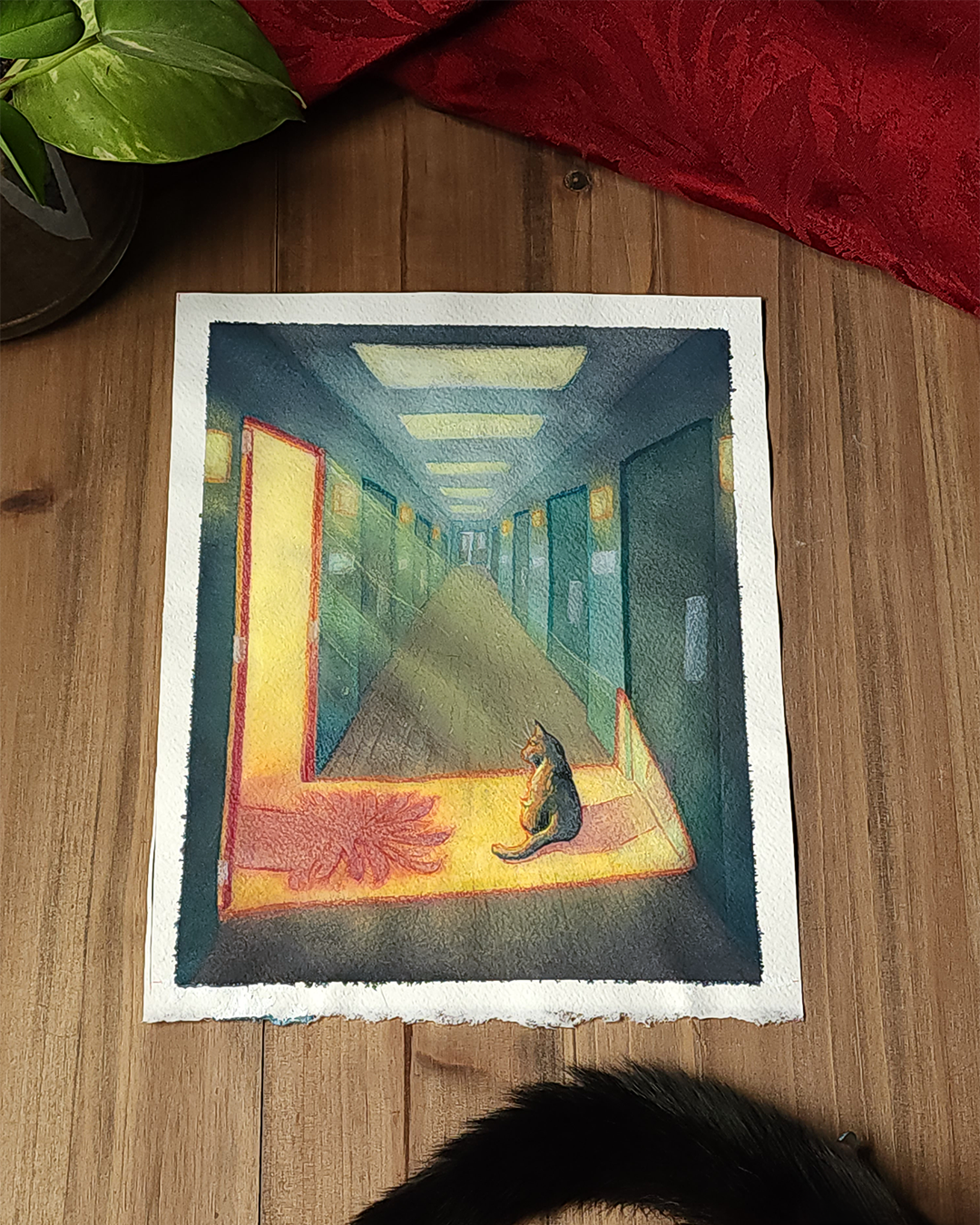
That is what Threshold is about.
It is born from that hard but honest, liminal moment. It's the moment when you look around and realize you are standing at the entrance to a new chapter you didn't write and didn't ask for. The room you came from (the life you had), the version of yourself that existed when that loved one was alive, is no longer there behind you.
The door just appears in front of you. You haven't walked through, you might not even feel remotely ready. But even as you grieve the person you lost, grieve the loss of your former self, you may not even understand the person you've become or what waits for you on the other side. But the Threshold doesn't close or disappear while you figure it out. It simply stays open, waiting for the next obvious step.
Threshold isn't the type of work that offers resolution, because I don't have one yet. It offers recognition, the kind where you can no longer look past what you have become. And unfortunately, it isn't necessarily comforting. If you have ever been suspended in the space between who you were and who you are becoming; between the life before and the uncharted path after, this work is for you. It is for the version of you that is still standing in the doorway, not entirely ready, but looking toward the light of the only direction left.
You don't have to be ready.
Just acknowledge you are standing at the Threshold.